Park at a Glance
Entirely north of the Arctic Circle in Alaska, Gates of the Arctic National Park and Preserve encompasses mountains, river valleys, and the living community of Anaktuvuk Pass.
What This Park Preserves
The park and preserve protect mountain watersheds, tundra, boreal forests, and archaeological traces of long human occupation. Protection also sustains traditional subsistence uses, alongside opportunities for wilderness travel without constructed roads or marked trails.
How This Place Was Protected
Wilderness advocates and local residents helped build support for protecting the central Brooks Range. President Jimmy Carter established Gates of the Arctic National Monument on December 1, 1978. On December 2, 1980, Congress established Gates of the Arctic National Park and Gates of the Arctic National Preserve, protecting wilderness and traditional subsistence uses. A 1996 land exchange adjusted ownership around Anaktuvuk Pass to support subsistence access.
Story of the Land
Colliding sections of Earth’s crust built the Brooks Range. Glaciers then carved valleys, lakes, and sharp ridges. At the Arrigetch Peaks, erosion exposed resistant granite that contrasts with the surrounding metamorphic rocks.
People & Culture
Iñupiaq and Koyukon Athabascan communities maintain relationships with these lands through hunting, fishing, gathering, and shared knowledge. Anaktuvuk Pass is a Nunamiut Iñupiat village within the park, with private lands and homes that visitors must respect.
Wildlife & Nature
Summer’s insects feed migratory birds and their chicks. Winter favors different adaptations: ptarmigan have feathered feet that spread their weight on snow, while voles and lemmings remain active in sheltered tunnels beneath it.
What to Look For
On a planned backcountry journey, compare broad glacial valleys with sharp ridges above them. Notice where spruce forests give way to low tundra vegetation. These transitions reveal how elevation and exposure shape the landscape.
Trails in Gates of the Arctic.
Explore 9 routes from the Park Passport Journey catalog. Find a signature hike, filter by difficulty or distance, and preview the route before your visit.
Explore all 9 Gates of the Arctic trailsSeasons and access at Gates of the Arctic.
Spring
Breakup can make essential river crossings impossible
Summer
Long daylight supports the main hiking and floating season
Fall
Early colors give way quickly to freezing rivers
Winter
Extreme cold and ice require specialized wilderness skills
These are general seasonal patterns. Check the official park website for current access, closures, and visitor requirements.
Four things to know about Gates of the Arctic.
Your parks, in one digital passport.
Use Park Passport Journey to scan and digitize your paper passport stamps. Keep your stamp images, park visits, and photos together, then turn your memories into a customizable scrapbook, postcard, or Instagram-ready visual.
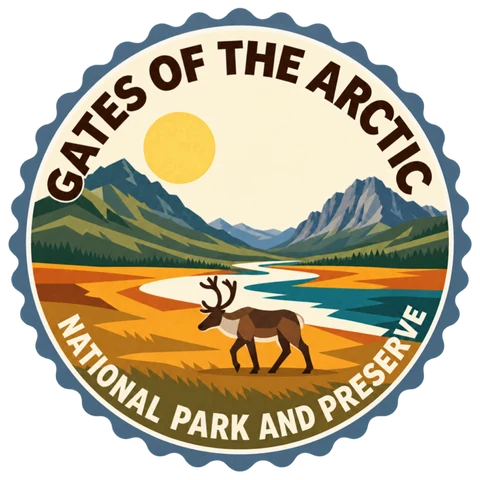
Gates of the Arctic passport stamp guide
Confirm stamp locations and availability with the park before your visit.